

For as long as I can remember, it has been a fact of business life that leaders sometimes have to have difficult conversations at work with employees. It is equally clear to me that the vast majority of the leaders I talk to would ‘rather put pins in their eyes’ than actually conduct these critical conversations.
So, we need to talk.
In this blog, Axiom founder and Managing Director, Chris Carey, explains why leaders simply have to ‘grasp the nettle’ and offer some practical insights on how to get to grips with the topic, so it is not so daunting.
The triggers for difficult conversations are on the increase
Many of the reasons we need to have difficult conversations are all too familiar:
- Employee performance issues
- Toxic behaviours in the workplace
- Punctuality and attendance problems
- Missed deadlines
- Non-compliance with policy or procedure
I could go on, but won’t, because there are more recently emerging issues that can now be added to the list:
- Global socio-economic developments
- Increasing polarisation among the workforce
- Emotionally charged topics, such as international conflict and tensions
- Multiple generations in the workplace
- Significant ongoing change, some driven by the rise of AI
- High-pressure, fast-paced working environments
- The increasing pressure to do more with less
Each of the above are triggering behaviours in so many ways, and certainly not making life any easier for leaders.
Whilst I appreciate that many of the topics in the second list are outside of your control, leading with empathy, listening to understand and handling a difficult conversation are certainly within your gift.
And certainly, from the feedback we get from participants who have recently benefited from our workshop on the topic, the thought of having to have these difficult conversations is often much worse than actually having them.
When do leaders and managers need to have difficult conversations with employees and why is it important?
Let’s tackle the topic of ‘why’ first.
Well, things rarely, if ever, get better on their own. Indeed, more often than not, this ‘conversation debt’, as it is sometimes called, just gets bigger and more costly – as do the issues you needed to address.
And then there is the impact of the behaviour your, let’s say, ‘underperforming’, or even ‘toxic’, colleague is having on the morale of the rest of the team, made worse by your apparent passive acceptance of it.
When should I have the difficult conversation at work?
I would argue that you have the difficult conversation the moment a one-off situation becomes a pattern. At that point, you also need to prioritise time to ensure you fully understand why the situation might be occurring, begin your fact-finding mission and start calmly preparing for the 1:1 that will need to follow.
We do indeed need to talk.
But there is an argument to be had that the conversation is already overdue.
Wouldn’t it have been better to have had ongoing and frequent discussions about performance as the year gathers pace, reinforcing what great looks like as you go along, not waiting for problems to escalate. You might, in fact, be part of the problem for not managing expectations in the first place.
Reducing the need for difficult conversations at source – the actions on you
In medicine, we often hear the phrase ‘prevention is better than cure’. Allow me to extend that thinking to the topic of this blog.
Let’s co-create a Collective Ambition for the entire workforce, a North Star that guides every action we take. This provides colleagues with a purpose and meaning for their work, and a framework to help align their personal goals; all factors which increase employee engagement and decrease ‘quiet cracking’.
Let’s curate a psychologically safe culture in which colleagues feel comfortable to speak-up and say what is truly on their minds to improve outcomes, without fear of consequence. This has been proven to be a real game-changer in driving organisational performance and minimising potentially disastrous outcomes.
Let’s evolve the way we listen, so we consciously listen to understand what the other person is saying. Most of us do not listen to understand; we listen to interrupt, so we can say what we want to say, often before the other person has stopped speaking.
Let’s embrace diversity in all of its guises. Research consistently tells us that we create better business outcomes when we fully harness diverse opinions and perspectives. But let’s push even harder on the topic now and embrace the diversity we get with multiple generations in the workforce and cognitive diversity too. Some people have their best ideas and insights days after a meeting finishes. We need to loop back around and capture them.
Let’s have frequent conversations with colleagues about their performance, rather than wait for the ‘annual review’, by which time they may be way off track and getting them back on course will be significantly harder. And let’s check-in with them regularly too, to see how they are doing as human beings, especially during these challenging times. How can you expect people to take an interest in driving success in your workplace if you don’t take an interest in them?
Let’s actually talk about the issues that might ultimately lead to a conversation, as opposed to ignoring them, hoping they’ll go away or burying your head in the sand.
How to handle difficult conversations – my number one recommendation
Perhaps the helpful hints in this blog came just too late, and now you’re in a situation where you just have to sit down and talk to a colleague who is causing concern or upset.
Perhaps you are new in the role and have inherited a situation that means that you now have to handle a difficult conversation.
Or perhaps you feel you’ve tried everything and now is the time to have that difficult conversation.
However you have ended up here, what would be my biggest recommendation about having difficult conversations? That’s easy… have them!
Yes, actually have them.
Stop putting them off or hoping that ‘Jupiter rising in Aries’, or some such, will make everything right… it won’t. Have them.
And keep in mind, research tells us that the majority of workers actually want to understand where they stand. They actually want constructive and even corrective feedback. It could be argued that for many, you are simply meeting their needs by having these conversations.
How do you manage and prepare for difficult conversations?
So, the time has come to actually have the difficult conversation. Here are proven steps to success for you to work through:
Be clear about where you are now
Before you sit down to talk, you’ll need to have done some solid preparation:
- What irrefutable facts and figures can you cite?
- What concrete evidence do you have, ideally directly observed, not hearsay, and never gossip
- What company policies or procedures will you need to be aware of and comply with?
- Do you need anyone with you in the meeting? Do they?
- What is actually going well that we can bank and build on?
- Remember, we attack the problem, not the person, so be careful with the language you use, try to take emotion out of the equation
- Put yourself in their shoes, could there be a ‘hidden’ reason why the issue has arisen?
- What questions could you ask to clarify the above?
- What support can you call upon if you uncover an issue that you are not equipped or qualified to tackle? It very rarely happens, but best to be ready just in case
Be clear about where you want to be in the future
- What would good look like going forward? Again, make it concrete: facts, figures, dates, deadlines, targets. You cannot correct your course if you do not know where you are headed together
- What needs to change? Do you both share the same vision of success?
- Remember, constructive candid feedback alerts an individual to an area in which his or her performance could improve. It is not criticism. It is descriptive and should always be directed to the actions taken, not the person
- The main purpose of constructive feedback is to help people understand where they stand in relation to expected and / or productive behaviour
Choose the right time and place for your discussion
- Think through when in the working week, and in the working day, it makes the most sense to have this conversation
- Respect your colleagues’ working hours, especially if they are dialling in from another time zone. Friday evening, their time, is rarely a good choice!
- Make sure you’ve scheduled enough time, this conversation matters
- You’ll need to book a room or find a physical space where you will not be overheard, either of you
- If you have to conduct this conversation remotely, double check the above still applies
- If you are meeting in-person, think about where you’ll sit in relation to your colleague. Does the room layout and seating arrangements signal you are working together to solve a problem, or adversaries locked in a battle of wills?
During your conversation
- Stay calm and manage your emotions
- Think about how you are going to start the conversation. Strike the right tone, for example, ‘Can we please work together today, to find a solution to something important I’ve noticed?’
- Demonstrate empathy, but stay focused on the outcomes you are there to co-create
- Don’t dance around the problem
- Be curious, ask plenty of good ‘open’ questions. Questions generate options; statements tend to generate resistance
- Remember, you are there to get the right outcome, not simply be right
- Listen – properly – to understand, not interrupt or talk over your colleague
- Be prepared to take a break if things get heated or emotional
Agree how you are going to get to where you want to be
- Work with your colleague to jointly agree on an improvement plan
- Define what actions need to take place. Who is going to do what? To what specific standard? By when? Checked by who?
- Agree when you are going to meet again, formally or informally, to check in on progress to date
- Be clear about the consequences of not achieving success, and clearly state what will be better when you do
- Double-check you have followed all appropriate internal policies
- Ensure your colleague is clearly signposted to any additional support or resources they may need or choose to call upon
- And as the conversation comes to a close, shift your language from ‘us’ and ‘we’ to ‘you’. For example: Have you got everything you need to deliver success? Are there any final reasons you can share why this plan won’t be successful? Can you share with me the first action you are going to take when you leave this meeting?
After the meeting
- Firstly, look after yourself. You’ve just had a difficult conversation after all, and that is always energy-sapping
- Your difficult conversation may have ended, but the process of delivering the mutually agreed solution has just begun
- Back everything up in writing, to a level of formality the situation and company policies call for
- Make sure you hit all of the agreed review dates. Missing even one of them will send a signal you did not intend to send
- Actively look for, and comment on, the improvements you are seeing in your colleague. As Ken Blanchard tells us, ‘Make someone’s day, catch them doing something right.’
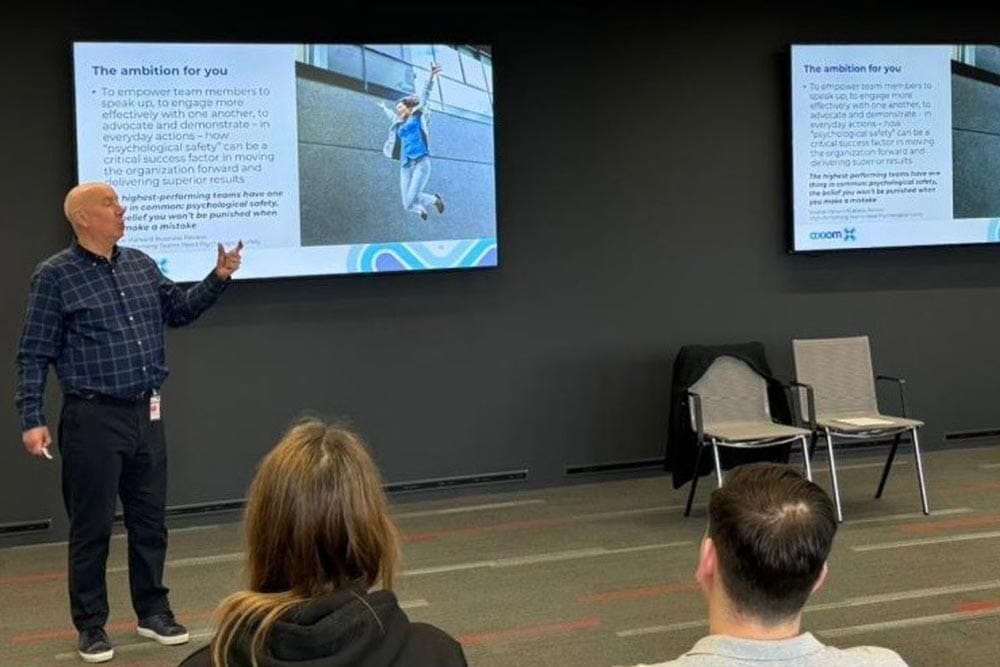 Axiom: Here to help you shape ‘How to have difficult conversations’ in your organisation
As I hope this blog clearly demonstrates, Axiom has a wealth of experience in helping leaders and line managers have difficult conversations. Equally, we can help you excite, inspire and align your colleagues to the extent that you do not need to have difficult conversations in the first place.
And there is so much more we can share to help you successfully navigate these challenging times than we could ever cover in a blog, even a detailed one like this.
Our workshop on ‘How to have difficult conversations’ can be tailored to meet your unique needs and address the real-world challenges you are facing. That way, the content we design and deliver is totally relevant and relatable to the challenges you face.
Book the workshop >We need to talk
Our ‘difficult conversations’ workshop is just one of over 60 skills development activities we have successfully delivered over the years to help leaders and their teams produce outstanding results, under four headings:


If you would like to find out more how we can help your organisation, your leaders and your people thrive… we need to talk!
Book a no obligation call >